


Measuring Customer Satisfaction with AI Phone Ordering Metrics in Restaurants
AI-powered Phone ordering is changing how restaurants take Orders by automating calls and cutting friction. Tracking Restaurant Customer Satisfaction with specific AI Phone ordering Metrics tells you whether the system is actually helping customers and where to focus fixes. The three core KPIs every Restaurant should watch are First Call Resolution, Voice‑Based Net Promoter Score (Voice NPS), and Average Handling Time. Together they show how well your Phone system resolves calls, signals Customer sentiment, and keeps speed—everything that affects repeat business and staff efficiency.
Why Focus on AI Phone Ordering Metrics to Measure Restaurant Customer Satisfaction?
Call transcripts and voice analytics give you signal you won’t get from occasional surveys or waiting for complaints. These Metrics record what happens on real calls, live, so you spot patterns and failures as they occur. You can tell whether problems come from the AI script, speech recognition, or handoffs to staff.
Accurately tracking AI Phone ordering Metrics enables restaurants to quickly identify breakdowns in service and act on them before the Customer ever hangs up frustrated.
The Three AI Phone Ordering Metrics That Matter Most

Your Phone system creates a lot of data. The trick is focusing on the handful of Metrics that actually predict Satisfaction and revenue. Here’s what each core KPI reveals.
First Call Resolution (FCR)
First Call Resolution measures the share of calls that finish successfully on the first try—Orders taken, questions answered, no callback needed. High FCR means the AI is completing transactions and reducing friction at the moment it matters. Research on First Call Resolution definition shows businesses with 70–75% FCR tend to lead their peers.
A low FCR signals customers are disconnected, transferred multiple times, or forced to call back—leading to lost Orders and Customer dissatisfaction.
Voice-Based Net Promoter Score (Voice NPS)
Voice NPS applies NPS thinking to actual speech. Instead of asking customers to fill out a survey, AI analyzes tone, pace, and sentiment during the call to estimate willingness to recommend. That gives you immediate feedback rather than delayed, low-response-rate surveys.
Knowing how Net Promoter Score (NPS) in voice interactions behaves helps you catch small shifts in Customer mood that presage churn or praise. Voice NPS gives you an ongoing pulse of Customer goodwill reflected not just in words, but in how they’re said.
Average Handling Time (AHT)
Average Handling Time records how long an AI call lasts from start to finish. Too long and callers get impatient; too short and you risk missed items or incorrect Orders. For most fast-casual menus, 2–4 minutes is a useful target, though complex catering Orders will run longer.
Tracking AHT lets you tune conversational flows so customers get what they need without wasting time, preserving accuracy and throughput.
How StrideQ Captures and Presents AI Phone Ordering Metrics in Real Time
StrideQ records and analyzes every call, then surfaces KPIs in a dashboard managers can use hourly or daily. The platform combines natural language processing with voice emotion detection and updates scores as calls complete. If FCR drops under 70% or Voice NPS falls below 50, the dashboard flags it so you can investigate right away.
The dashboard shows:
- FCR percentages: filterable by time, location, or menu items
- Voice NPS trends: sentiment over time, highlighted when dips occur
- Average Handling Time Metrics: visual breakdowns of call stages such as greeting, order taking, and confirmation
Users can drill down to transcripts, keyword heatmaps, and sentiment timelines to find recurring friction or transcription errors.
How StrideQ’s AI Phone Ordering Works goes into the technical details behind these analytics.
Interpreting Dashboard Data to Improve Your AI Phone Ordering System
Seeing a dip in a metric is only the start. You need a repeatable process to diagnose root causes and push fixes. Here’s a practical sequence we recommend for analyzing issues and improving outcomes:
| Step | Action | Settings/Thresholds | Decision Criteria |
|---|---|---|---|
| 1. Monitor KPIs Daily | Check FCR, Voice NPS, and AHT every day on the dashboard | FCR below 70%, Voice NPS under 50 points, AHT above 4 mins | Trigger in-depth call review if any Metrics cross thresholds |
| 2. Review Sample Calls | Listen to flagged calls focusing on transfers, repeated ordering, or negative sentiments | Pick minimum 10 random calls per metric dip for pattern analysis | Identify if issues come from AI script gaps, recognition errors, or UI delays |
| 3. Adjust AI Scripts or Prompts | Update menu prompts, clarify confusing steps, or fix misrecognized words | Implement new version and monitor impact on KPIs for 7 days | Improvement: FCR +5%, Voice NPS +10 points, or AHT -15 seconds |
| 4. Train Staff on Escalations | For hybrid calls, ensure staff follow up methods reduce repeat calls | Average call transfers drop below 10% | If transfers remain high, revise escalation guidelines |
| 5. Reassess and Iterate | Continue periodic KPI reviews and refine the system continuously | Maintain consistent or improving scores | Repeat cycle monthly or after major menu changes |
This exact cycle has helped restaurants using StrideQ cut repeat calls by 20% and boost Customer recommendation likelihood within weeks.
What Common Mistakes Restaurants Make Measuring AI Phone Ordering Metrics
Many operators look only at call volume or average wait time and assume that tells the whole story. It doesn’t. Avoid these common blind spots when you work with AI Phone automation analytics:
- Ignoring qualitative context: Numbers without call content won’t tell you why customers hang up or get frustrated.
- Over-focusing on speed: Driving AHT down too far often reduces order accuracy.
- Neglecting Voice NPS: Skipping sentiment analysis means you miss subtle signals that affect loyalty.
- Delaying action: Not setting clear thresholds lets avoidable problems persist.
Use these Metrics together, not in isolation, so you can make evidence-based changes that stick.
Additional Metrics Worth Tracking
Beyond the three core KPIs, several secondary Metrics help you pinpoint operational and revenue opportunities. Monitor these alongside FCR, Voice NPS, and AHT to get a fuller picture.
- Containment Rate: Share of calls handled entirely by the AI, without escalation. High containment with good Voice NPS means customers are satisfied with self-service.
- Transfer Rate: Percentage of calls routed from AI to a human. A sudden rise often points to script gaps or recognition failures.
- Order Accuracy Rate: Share of Orders that match POS receipts and kitchen tickets. This ties directly to revenue retention and waste reduction.
- Conversion Rate (Calls to Orders): Percent of inbound calls that result in completed Orders, useful for tracking promo effectiveness.
- Revenue Per Call: Average dollar value of Phone Orders, handy for ROI calculations on AI improvements.
- Sentiment Score: Composite index from Voice NPS and emotion detection; useful for trend analysis and coaching.
Tracking these secondary Metrics with your primary KPIs gives you a clearer line of sight to profitable improvements.
Benchmarks and Industry Statistics
Benchmarks set useful expectations, though they vary by cuisine, region, and order complexity. A few practical guidelines:
- Typical FCR for service businesses runs from 60% to 80%; top performers often exceed 75%.
- Voice NPS varies widely—aim for steady positive sentiment and month-over-month gains rather than a single big jump.
- AHT sweet spots usually sit between 2 and 4 minutes for fast-casual spots; delivery and catering will be longer.
Restaurants that measure and act on Phone ordering analytics typically see lower call abandonment, fewer incorrect Orders, and higher conversion on promotions. Targeted efforts to reduce repeat callbacks often cut food waste and lift same-store sales by reducing refunds and remakes.
Deeper Examples: Translating Metrics into Customer Experience
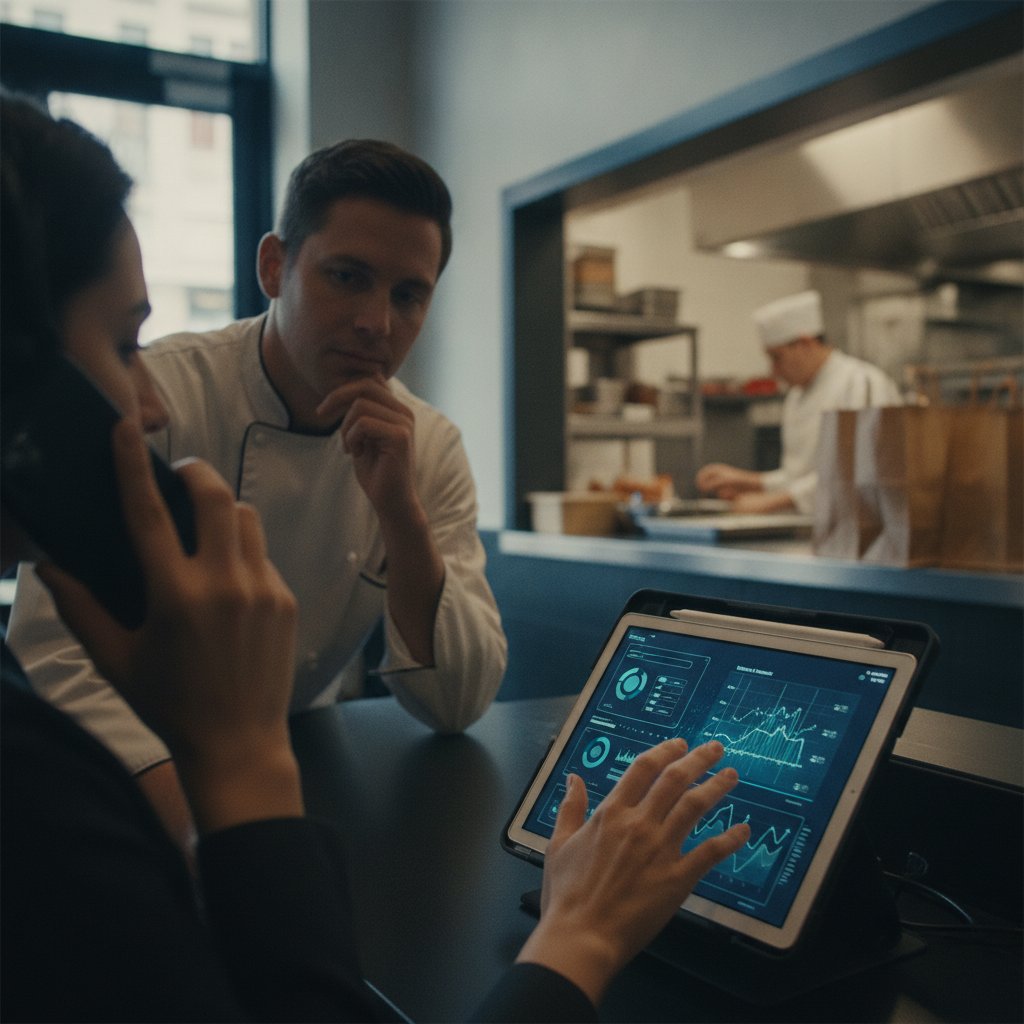
Concrete examples show how metric changes map to better Customer experience:
- Example 1 — Improving FCR: A sandwich shop had 58% FCR because callers often dialed back to fix pickup times. Adding a clear confirmation step and a simpler time-picker boosted FCR to 75% and cut callbacks by 35%. Staff saw fewer rushed remakes.
- Example 2 — Raising Voice NPS: A bakery had neutral Voice NPS scores. Updating the AI to use short, empathetic confirmations (“I understand you’d like pickup at 11:30 — is that correct?”) lifted sentiment, and repeat callers started mentioning the “friendly” automated voice in casual feedback.
- Example 3 — Balancing AHT: A pizzeria’s AHT was 5:30 because the menu script was too wordy. Trimming nonessential prompts and offering a “repeat menu” option cut AHT to 3:45 with no rise in errors, which improved throughput during peak times.
Two Real-World Case Studies
Case Study A — Neighborhood Pizza (Single Location)
Challenge: Neighborhood Pizza relied on one person to answer phones, so the lunch rush created long waits and missed Orders. Complaints about wait times climbed.
StrideQ Implementation: The Restaurant put StrideQ’s AI Phone ordering in place to handle routine Orders, confirm pickup windows, and capture special instructions. Staff only got alerts when calls were ambiguous.
Outcome (8 weeks):
- FCR improved from 62% to 80%
- AHT decreased from 5:10 to 3:30
- Repeat calls due to order issues fell by 22%
- Owner reported a smoother lunch rush and fewer lost Orders
Lesson: Automating routine Phone interactions frees staff to focus on in-store service and reduces friction at peak times.
Case Study B — Regional Café Chain (8 Locations)
Challenge: The chain had inconsistent Phone experiences across stores and no consolidated analytics. Staff handled escalations differently, so managers couldn’t compare KPIs.
StrideQ Implementation: The chain deployed StrideQ across locations with a centralized dashboard and store filters. Prompts were standardized while allowing local menu overrides. Weekly reviews used transcripts to find common issues.
Outcome (12 weeks):
- Average store FCR rose from 68% to 77%
- Voice NPS improved by an average of 9 points across locations
- Order accuracy improved, cutting waste and remakes by about 12%
- Managers used real calls to improve training and coaching
Lesson: Multi-unit operations gain from centralized insights that enforce consistent service and speed up iteration on best practices.
Implementing a Continuous Improvement Program (CIP)
To keep gains, run a Continuous Improvement Program focused on Phone ordering Metrics. Use this roadmap to make improvements repeatable and measurable:
- Set a Baseline: Record 30 days of pre-change data for FCR, Voice NPS, AHT, and Order Accuracy.
- Prioritize Fixes: Use an impact-versus-effort matrix to pick changes (for example, fix a widely misrecognized menu item before reworking whole flows).
- Test Small: Roll updates out to one location or off-peak hours to measure effects before a full rollout.
- Measure Rigorously: Track the same KPIs daily and apply basic significance tests for big changes so you know results aren’t random.
- Document & Share: Keep a change log of prompts, model updates, and training so improvements travel across locations.
- Celebrate Wins: Share improvements with staff to reinforce the behaviors that boost Satisfaction.
Regular, disciplined iteration on scripts and processes turns call analytics into sustained operational advantage.
How StrideQ Helps You Stay Ahead with AI Phone Ordering Analytics
StrideQ’s AI Phone ordering system delivers these analytics in a way managers can act on. You get numbers and context for each call, which makes it simpler to improve Phone service in measurable ways. Whether you run a single shop or a regional chain, StrideQ scales to your needs and gives you visibility into this Phone channel.
Frequently Asked Questions
What is First Call Resolution and why does it Matter for Restaurant Phone Orders?
First Call Resolution measures the percentage of calls that complete successfully on the first attempt without callbacks or transfers. Customers expect fast, hassle-free ordering; low FCR means lost sales and unhappy customers. See First Call Resolution definition for more.
How does Voice NPS differ from traditional feedback surveys?
Voice NPS analyzes Customer sentiment during the call using tone and emotion signals rather than waiting for explicit survey responses. It captures immediate Satisfaction signals, giving more accurate, timely feedback than post-call surveys. More details at Understanding Net Promoter Score (NPS) in voice interactions.
What’s an ideal Average Handling Time for AI Phone ordering in restaurants?
AHT typically runs between 2 and 4 minutes per call. Faster calls risk skipping details or upsetting customers; longer calls increase wait times and costs. Find the balance that fits your menu complexity.
Can StrideQ’s system integrate with existing POS and CRM tools?
Yes. StrideQ offers integrations to sync call order data with your point-of-sale and Customer relationship management tools to provide cohesive Customer profiles and streamline operations. Details on integration options can be found at How StrideQ’s AI Phone Ordering Works.
How quickly can I see improvements in Customer Satisfaction after implementing StrideQ?
Many restaurants report measurable KPI improvements, including higher FCR and Voice NPS scores, within 2–4 weeks of implementation when they follow data-driven adjustments and continuous monitoring.
How accurate is voice recognition for different accents and noisy environments?
Modern ASR models are trained on diverse datasets and handle many accents well. High ambient noise or strong local dialects can still reduce accuracy. StrideQ reduces errors with noise-resistant transcription models, confidence scoring to flag uncertain phrases, and escalation flows that route unclear calls to a human.
Does StrideQ support multilingual Phone ordering?
Yes. Multilingual support covers major languages and dialects. You can enable language detection, offer menu choices in multiple languages, and hand off to bilingual staff when needed.
What data privacy and security measures are in place?
Protecting Customer data is a priority. StrideQ supports secure call recording storage, role-based access controls, TLS encryption in transit, and configurable data retention policies. For payment data, StrideQ integrates with systems that keep PCI-sensitive information out of recordings using tokenization and compliant workflows.
How should I measure ROI for an AI Phone ordering system?
Measure ROI with direct and indirect benefits: fewer order errors and remakes, higher completed Orders, labor savings, increased peak throughput, and improved lifetime value from happier customers. Track Revenue Per Call and Order Accuracy before and after deployment to quantify impact.
What happens if the AI makes an error on an order?
StrideQ uses confirmation steps, confidence scoring for critical fields such as address and modifiers, and fast escalation to staff when confidence is low. Post-call analytics make it straightforward to spot recurring errors and update scripts or recognition settings.
How long does it take to get started with StrideQ?
Timelines vary by complexity, but many restaurants go live within 2–6 weeks, including POS integration, initial script setup, and staff training. A pilot period with close monitoring helps ensure a smooth rollout.
Test StrideQ’s AI Phone Ordering System Risk-Free
You can start tracking these AI Phone ordering Metrics with StrideQ and see the difference for yourself. Our platform offers a risk-free trial so your team can experience how real-time insights improve Restaurant Customer Satisfaction and Phone order efficiency. Visit the StrideQ Blog for ongoing tips and use cases to maximize results.