

Missed Call Recovery: Turn Lost Calls into Restaurant Revenue with StrideQ
Quick Answer: Missed Call recovery catches every unanswered ring, instantly schedules a callback, sends a personalized SMS, and often turns that Missed interaction into a confirmed order within minutes. StrideQ’s AI handles this automatically, turning lost Calls into concrete Revenue without any manual work.
Every Missed phone Call is a lost customer walking out the door. The Statista report on Missed Calls in U.S. Restaurants reports that peak hours see Up to 30% of inbound Calls go unanswered. That translates directly into empty tables, Missed catering gigs, and smaller check sizes. Let a Call slip through, and you’ve just handed a lead to your competition.
How Missed Call recovery Boosts Restaurant Sales
Missed Call recovery isn’t jargon — it’s a Revenue lever. StrideQ’s AI spots a Missed Call immediately, ranks it by urgency, and schedules a callback while firing off a tailored SMS confirming your availability. That personal touch makes guests feel noticed — and more likely to book or order.
Restaurants using Missed Call recovery see conversion rates from phone inquiries climb by 12–18%. This boost comes from faster responses, customized messaging, and automated Follow-ups that nudge hesitant callers toward reservations or orders.
StrideQ integrates with your existing systems; no need to replace your phone setup. It monitors your line silently and kicks into action when a Call goes unanswered.
What does StrideQ’s AI callback Workflow do?
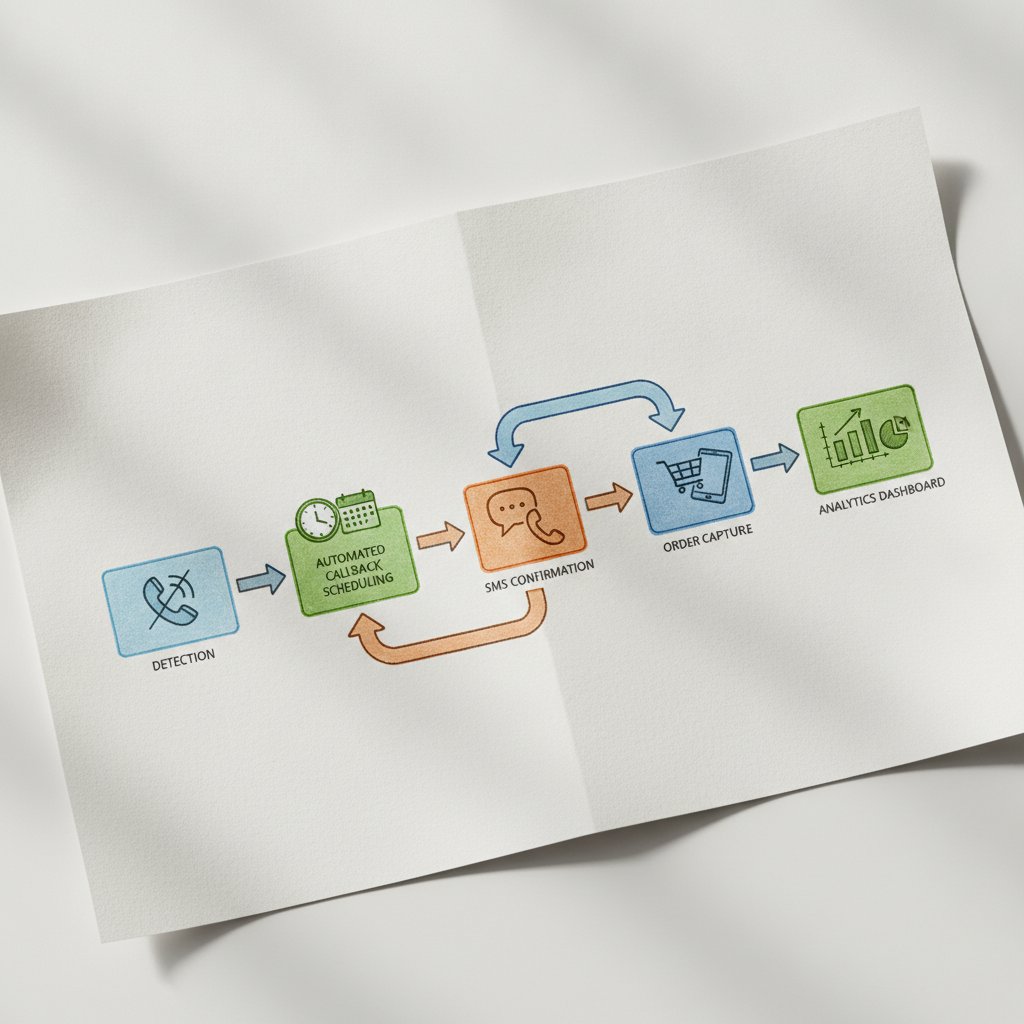
In short, it:
- Detects a Missed Call the instant it happens.
- Schedules a callback that fits your kitchen’s current capacity and staffing.
- Sends a custom SMS with a short menu link or catering form.
The AI uses caller ID and time of day to prioritize lunch callers over late-night ones. Interactions automatically log into your CRM system, so you track every connection.
This creates a smooth bridge from Missed Call to confirmed order, all without manual dialing.
Step‑by‑step Workflow to Turn a Missed Call into a sale
Here’s the Workflow we recommend for full- or quick-service restaurants running StrideQ.
- Missed Call detection: StrideQ monitors your line all day. If a Call rings unanswered after 15 seconds, it flags the event.
- Priority assignment: The AI checks the time, current order load, and any active promos. Lunch-hour Calls get top priority.
- Callback scheduling: High-priority Calls get a callback within 5 minutes. Lower priorities have a 15-minute window.
- Personalized SMS dispatch: An SMS fires off simultaneously: “Hi [First Name], we Missed your Call. Here’s our lunch menu: [short link]. Reply ‘YES’ to speak with a manager.”
- Agent handoff: When the guest replies or picks Up, the Call routes to the next available staffer with a pop-Up showing the caller’s reason.
- Order capture: Staff confirm the order, add upsells, and close payment. AI updates inventory and logs the sale.
- Post-order Follow-Up: Afterward, an automated thank-you text with a review link goes out, encouraging repeat visits.
Follow these steps, and no Call gets left behind.
Real‑world results from our Restaurant partners
Our Restaurant partners report solid gains from Missed Call recovery.
| Metric | Before StrideQ | After StrideQ (3 months) |
|---|---|---|
| Missed‑Call rate | 28% | 9% |
| Call‑to‑order conversion | 4.2% | 7.9% |
| Average order value | $27 | $33 |
| Monthly Revenue uplift | $12,400 | $15,800 |
The numbers don’t lie: Missed Call recovery puts dollars on your bottom line.
One downtown bistro with 60 seats reported a $3,400 weekly jump in catering bookings just by adding the AI-driven Follow-Up SMS linking directly to a catering form. That form captures guest details, event size, and preferences — turning a casual inquiry into a booked event.
Key performance indicators you should track
We provide a free KPI tracking sheet to help you measure success. Track weekly:
- Total Calls received
- Missed Calls
- Callbacks completed
- SMS open rates (via short-link analytics)
- Conversion rate (Calls to orders)
- Monthly Revenue uplift
When Missed-Call rates drop below 10% and conversions climb above 8%, your system is earning its keep.
Common pitfalls and how to avoid them
Many restaurants jump in with simple auto-dialers and end Up frustrating callers. The pitfalls we see most often:
- Generic SMS messages: Guests quickly recognize copy-paste texts. Use dynamic fields like first names, time-sensitive offers, and direct menu links.
- Callbacks scheduled too late: A 15-minute delay kills momentum. Keep callbacks within five minutes for high-priority Calls.
- Ignoring CRM integration: Without logging, you lose insights for future marketing segmentation.
- Skipping staff training: Employees must know how to read pop-Up notes and close orders fast.
Our implementation guide walks you through all this. Do it right—and the AI becomes a reliable team member.
Fixing these common mistakes lets the system work for your business, not against it.
Frequently Asked Questions
How quickly does StrideQ send the Follow‑Up SMS after a Missed Call?
The SMS goes out within 3 seconds of detecting the Missed Call. That keeps the experience fresh for your caller.
Can I customize the SMS content for lunch specials versus dinner promos?
Absolutely. You can create multiple templates triggered by time of day, each with embedded short URLs pointing to dynamic menus.
Do I need a separate phone line for the AI system?
Nope. StrideQ works with your existing inbound line via SIP or PSTN, so there’s no extra hardware cost.
What happens if the guest never replies to the SMS?
If no reply comes in, the AI tries a second callback about 10 minutes later, then logs the no-response event for future review.
Is there a contract or can I try it risk‑free?
We offer a 30-day risk-free trial. If you don’t see measurable Revenue lift, cancel anytime—no penalties.
Ready to stop losing money on Missed Calls? Start your risk-free trial today and watch how Missed Call recovery drives your Sales Up.
Deep dive: How the AI prioritization logic actually works
The priority engine is what turns simple callback systems into Revenue multipliers. StrideQ pulls together multiple real-time data points to decide which Missed Calls deserve immediate attention:
- Time of day: Calls during lunch and dinner get priority.
- Caller history: Repeat visitors or VIPs jump the queue.
- Current kitchen load: The AI checks your POS and inventory to avoid over-promising when the kitchen’s slammed.
- Campaign tags: Active promos like catering specials bump relevant Calls higher.
- Estimated value: The system evaluates caller intent based on IVR inputs or CRM notes to spot high-value leads.
All these factors combine into a priority score from 0 to 100. Calls above your threshold get a 5-minute callback window; others wait longer or rely on SMS-only Follow-Up. This helps your staff spend time where it pays off most.
SMS template examples and A/B testing insights
Not all texts drive the same results. We run A/B tests constantly; here are some typical winners:
- Template A (Direct & action oriented): “Hi [FirstName], we Missed your Call. We have availability now. Reply YES to speak with a manager or click [link] to view the menu.” — Reply rates: 10-14%.
- Template B (Value driven): “Hi [FirstName], sorry we Missed you. Show this link for 10% off your next pickup: [link]. Reply CALL to chat now.” — Reply rates: 12-16%, with stronger immediate orders if the discount hits home.
- Template C (Catering lead capture): “Planning an event? Tell us party size & date here: [catering link]. A manager will Call within 15 minutes.” — Form completion rate: 18-22% for catering inquiries.
Run each test for at least 2 weeks or 1,000 Missed Calls to ensure meaningful data. We usually start with Template A vs. B on general Missed Calls, and Template C when the system flags catering intent.
Calculating ROI — a worked example
To show how Missed Call recovery pays, here’s an example for a mid-size Restaurant:
- Inbound Calls/month: 2,000
- Missed Call rate before StrideQ: 28% (560 Calls)
- Call-to-order conversion before: 4.2%
- Average order value (AOV) before: $27
- Missed Call rate after StrideQ: 9% (180 Calls)
- Call-to-order conversion after: 7.9%
- AOV after: $33
Before StrideQ, monthly phone Revenue was roughly:
(2,000 × 72% answered) × 4.2% conversion = 1,440 × 0.042 ≈ 60.5 orders → $1,633/month.
After StrideQ:
(2,000 × 91% answered) × 7.9% conversion = 1,820 × 0.079 ≈ 144 orders → $4,747/month.
The net uplift? About $3,114 more per month. Many clients see 2–3 times this boost within three months once upsells and catering start contributing. Compared to the cost of StrideQ—usually a fraction of this uplift—most see payback in under 45 days.
Extended case studies
Case Study 1 — “The Brick & Barrel” (60-seat downtown bistro)
Missed Calls during lunch were common, and catering inquiries often got lost. After integrating StrideQ and adding catering form links in SMS, Missed Calls dropped 50%, weekly catering revenues jumped by $3,400, and repeat customer tags increased 22%.
Case Study 2 — “Family Pie Co.” (suburban pizza chain, 12 locations)
Peak Call volumes meant long waits and losing orders to third-party delivery apps. Post-StridQ, Missed Calls fell from 35% to 8%. Direct orders climbed, average order value rose by $4, and margins improved by cutting aggregator fees.
Case Study 3 — “Events by Marlow” (catering specialist)
High-value catering leads routinely went to voicemail, losing contracts. StrideQ’s fast callback prioritization (under 2 minutes) and routing to dedicated Sales managers doubled catering conversion from 15% to 33%. One recovered lead alone booked $12,500.
Compliance, privacy, and data security
Automating callbacks and SMS means compliance can’t be an afterthought. StrideQ builds in safeguards to meet regulations:
- TCPA and opt-in: Messages include opt-out info, and opt-ins are logged when customers provide numbers.
- Data retention: You set your own policies for Call recordings, SMS archives, and CRM notes; defaults Follow industry standards.
- Encryption: Data is encrypted in transit with TLS and at rest.
- Regional rules: For GDPR areas, we can configure data handling to respect subject requests and limit processing.
Always check with your legal counsel to align with local telemarketing laws before launching Call campaigns.
Implementation timeline and staff training
Most rollouts take 1–4 weeks, depending on integrations:
- Week 1: Line integration (SIP/PSTN), template setup, and priority rule configuration.
- Week 2: CRM and POS integration; initial staff training; load A/B SMS templates.
- Week 3: Pilot phase with one or two locations; KPI tracking begins.
- Week 4: Full rollout and optimization based on pilot feedback.
Training focuses on reading pop-ups, following scripts, and tracking conversions in POS—all usually mastered within a single shift.
Advanced integrations that compound value
StrideQ integrates with:
- POS systems for order status updates and tracking AOV shifts.
- Inventory management to avoid scheduling callbacks that exceed kitchen capacity.
- CRM and loyalty platforms to tag customers and automate segmented marketing.
- Marketing automation to run targeted SMS campaigns based on caller data.
Bringing these data streams together Boosts Sales lift by connecting phone engagement directly to Revenue insight.
Richer FAQ
Can StrideQ handle multiple languages?
Yes. Automated SMS templates and basic IVR prompts can run in multiple languages. Callbacks route to staff fluent in the caller’s preferred language when you supply that info.
How does StrideQ avoid calling Back spam or robocalls?
It uses heuristics to spot likely spam—such as volumes of short Calls or flagged numbers—and deprioritizes them. You can also maintain a custom blocklist. This avoids wasting callbacks on spam.
Does StrideQ work with shared lines and Call centers?
Yes, it supports shared lines and multi-location Call centers with flexible routing by location, shift, or staff role.
What analytics are available?
Dashboards track Missed-Call rates, callback completions, SMS open and click rates, template conversion, and Revenue linked to recovered Calls. You can export data for deeper analysis.
How customizable are the callback windows and Follow-Up rules?
Highly customizable. You set global defaults and override them by location, time window, or campaign. Some customers assign different rules for delivery, reservations, or catering.
What support and onboarding are included?
StrideQ offers a dedicated onboarding specialist, training materials, plus optional on-site or virtual staff training. Ongoing support comes via chat, email, and phone.
Ready to stop leaving money on the line? Start your risk-free trial today and watch Missed-Call Revenue grow.