


Centralized AI Phone Ordering: Boosting Multi‑Location Restaurant Chains
Quick answer: Centralized AI phone ordering lets one AI-powered hub manage calls for dozens of restaurant locations, delivering a consistent ordering experience, real-time data aggregation, and measurable revenue gains. It cuts labor costs, reduces order mistakes, and feeds a unified analytics dashboard that propels restaurant technology growth.
What is centralized AI phone ordering and how does it work?
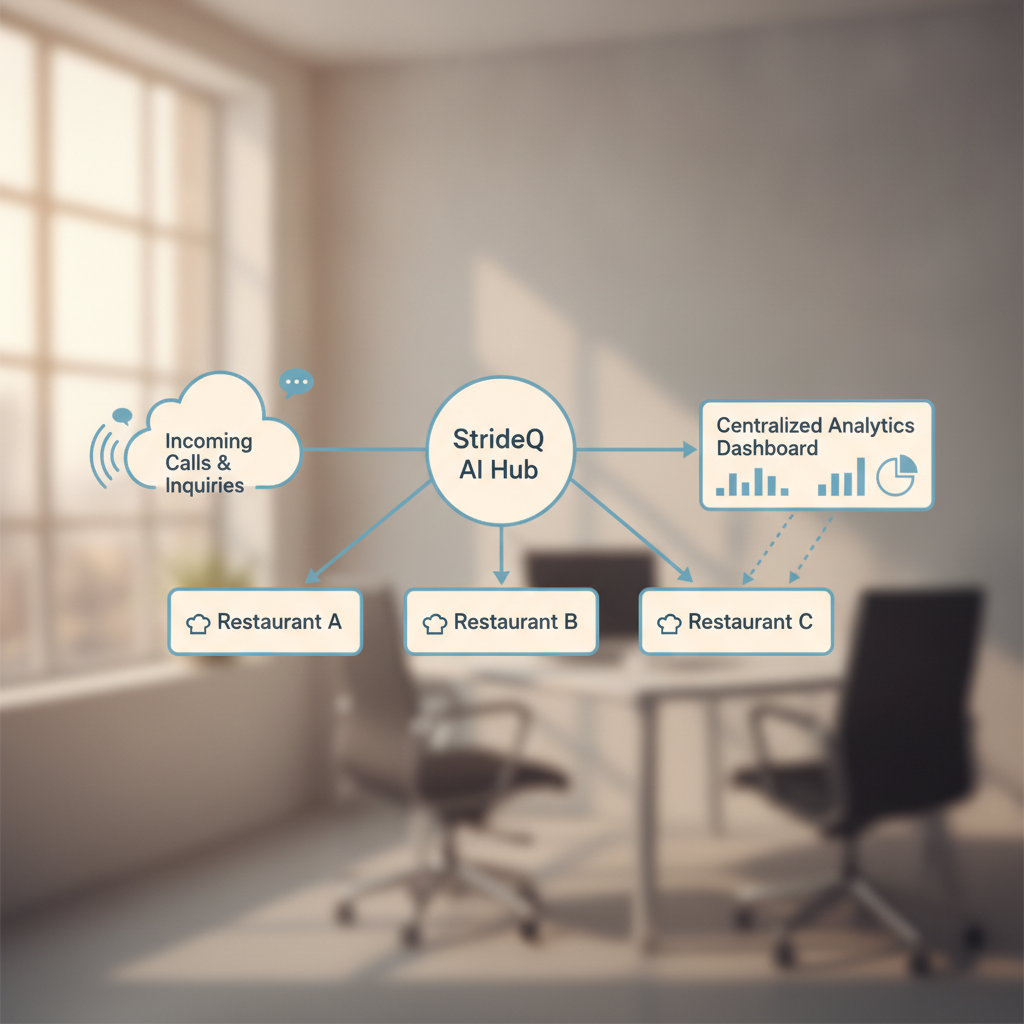
Centralized AI phone ordering funnels all incoming calls through a cloud-based AI engine that knows your menu inside out, handles special requests, and confirms payment without involving a human operator. It plugs directly into each location’s POS, so orders land exactly where they belong. Since the logic lives centrally, updates happen once and propagate across every site.
Our How StrideQ works page walks through the flow: callers dial a toll-free number, the AI greets them, asks which location they want, guides them through the menu, confirms the order, and escalates to a live agent only if necessary. It feels like chatting with a knowledgeable host — not a script.
Key takeaway: a single AI hub replaces dozens of separate phone lines, ensuring every location offers the same reliable ordering experience.
Why do multi‑location chains choose a centralized AI phone ordering SaaS?
Operators managing 10, 20, or 100 locations quickly hit limits with hiring staff for phone orders. No-show shifts, turnover, and spotty training all chip away at profits. Centralized AI cuts through those challenges.
- Consistent brand voice — the same greeting, tone, and upsell language at every site.
- Unified data — every call logs into a central database for chain-wide insights.
- Scalable costs — you pay per call or minute, not by employee hours.
McKinsey’s research shows AI phone automation cuts labor costs by 15–20% and improves order accuracy by as much as 30%.
Key takeaway: the SaaS model cuts cost per order and lets chains grow without inflating headcount.
How does centralized phone automation drive restaurant technology revenue growth?
The revenue boost hinges on three factors.
- Higher average order value. The AI suggests add-ons based on past customer choices, nudging checks up 5–10%.
- Fewer order mistakes. Reducing refunds and ingredient waste preserves your margins.
- Quicker calls. AI wraps up 20–30 seconds faster than humans, freeing lines for more business.
Stack a 7% bump in average ticket with a 12% waste cut, and you’ll see revenue increases that often cover subscription costs within the first three months.
Statista projects 38% of restaurants will use AI by 2025, proving early adopters grab a real edge.
Key takeaway: this platform pays for itself by boosting ticket size, cutting waste, and handling more orders per hour.
How do I roll out centralized AI phone ordering across my regional chain?
Rolling out smoothly means following a careful plan. Skip steps, and you risk data silos or inconsistent brand voice.
- Audit current phone workflows. Chart call patterns by location — peak hours, top menu picks, error hotspots.
- Pick a pilot group. Select 3–5 locations that represent your geography and have solid internet.
- Set up the AI bot. Upload menus, prices, and special-event changes into the SaaS dashboard. Define language and escalation triggers (e.g., “I want to speak with a manager”).
- Run a soft launch. Send 10–15% of calls to AI, keeping the human line open. Track completion, accuracy, and customer feedback.
- Analyze pilot results. Use unified reports to compare AI to humans. Look for at least 5% order value lift and error rates below 2% before expanding.
- Scale gradually. Boost AI call share by 20% weekly until fully deployed. Tune prompts based on feedback.
- Train staff on escalations. Prepare front-of-house teams to handle calls the AI hands off smoothly.
- Finalize reporting. Set up daily dashboards tracking orders by location, item, and time. Use this for inventory and targeted promos.
This eight-step approach keeps things predictable and avoids “big bang” launches that overwhelm support.
Key takeaway: a phased, data-driven rollout keeps brand voice consistent and ensures every location benefits equally.
Traditional phone ordering vs. centralized AI phone ordering
| Metric | Traditional Human Line | Centralized AI Phone Ordering |
|---|---|---|
| Average Call Duration | 2 min 30 sec | 1 min 45 sec |
| Order Error Rate | 3.2 % | 0.9 % |
| Labor Cost per Call | $0.75 | $0.30 |
| Upsell Capture Rate | 4 % | 9 % |
The numbers are clear: AI shortens call times, slashes errors, doubles upsell rates, and cuts labor costs.
Key takeaway: centralized AI wins operationally and financially when stacked against traditional phone lines.
Common pitfalls and how to avoid them
Even with a solid plan, some traps catch teams off guard.
- Dirty data. If menu SKUs aren’t clean, the AI mishears orders. Run nightly data syncs.
- Too many escalations. Setting escalation triggers too low wastes human effort. Start with a 90% confidence threshold, then fine-tune.
- Ignoring local flavor. One script doesn’t fit all. Add location-specific promos during setup to keep calls relevant.
- Skipping post-call analysis. Most track only call volume. Dig into order-value increase and error types to improve the AI model.
Working with our restaurant partners shows addressing these points early prevents most rollout headaches.
Key takeaway: clean data, smart escalation settings, local customization, and thorough analytics build a smooth rollout.
Frequently Asked Questions
Can the AI handle large catering orders?
Yes. The AI guides callers through bulk item selection, delivery windows, and payment. It then creates a single POS ticket the catering manager can edit before confirming.
What happens if the internet drops at a location?
The system reverts to a local IVR that records orders and syncs them once connectivity is restored. No orders get lost, and customers receive confirmation texts.
Do I need to replace my existing POS?
No. StrideQ smoothly integrates with most major POS platforms via API, translating AI orders into your system’s format.
How secure is the phone‑order data?
Data in transit is protected with TLS 1.3 encryption; stored data lives in a PCI-compliant vault. Access follows strict roles, and audit logs are retained for 12 months.
Is there a minimum contract length?
We offer a 30-day risk-free trial with no commitment. After that, choose month-to-month plans or discounted annual subscriptions.
Take the next step with a risk‑free trial
If you want to see how centralized AI phone ordering can grow your chain’s revenue, start a free 30-day trial now. We’ll set up your hub, connect menus, and pilot at one store—all at no cost to you. Join our partners already enjoying consistent service, clearer data, and better profits.
Real‑world case studies: What early adopters are seeing
Numbers tell one story, but concrete examples prove how centralized AI performs under real conditions. Here are three anonymized case studies from our pilots and partners.
Case study 1 — Regional Pizza Chain (45 locations)
A family-owned pizza chain with 45 locations struggled with uneven customer experiences and heavy dinner rush calls. Each store had its own phone setup and patchy upsell prompts.
We ran an eight-week pilot in 8 representative locations, integrating POS and loyalty systems. AI handled 30% of calls in week one and 100% by week six.
Results over 90 days:
- Average order value rose 9%, thanks to targeted offers like garlic knots and 2-liter soda upsells.
- Order errors dropped from 3.5% to 1.0%.
- Phone duty hours shifted toward delivery and prep, cutting overtime by 18%.
- Incremental revenue covered platform costs within nine weeks.
Case study 2 — Fast-casual Salad Chain (12 locations)
Fast ordering cycle with lots of customization — proteins, dressings, substitutions. Customers valued speed and personalization.
The AI pilot ran two months, using natural language tuned to complex ingredient combos and past order history for return callers.
Results:
- Average call time shrank by 35 seconds, increasing capacity during peak hours without extra staff.
- Repeat order frequency among registered users jumped 7%, thanks to AI recalling preferences.
- Manager escalations fell 40% due to clearer confirmation prompts.
Case study 3 — Catering-focused Bakery (8 locations)
The bakery phones volume was heavy with event orders needing multiple follow-ups and quotes.
The AI took initial orders, created editable POS estimates, and handed logistics to human managers.
Results:
- Catering lead capture rose 60%, as AI handled after-hours calls and booked tentative orders.
- Lead-to-paid order conversion improved 22% when managers followed up on AI intakes.
These cases show centralized AI can tune its focus — whether your priority is higher average order value, speed, or lead capture.
Implementation technical checklist (detailed)
Technical precision matters. Use this checklist when coordinating with IT and your vendor.
- Network & bandwidth: Stable internet with QoS for voice; aim for under 150ms latency and under 30ms jitter to the AI hub.
- SIP trunking & routing: Centralize DID management; confirm failover routes in case your primary carrier goes down.
- Security: Use TLS 1.3 for signaling, SRTP for media. Reduce PCI-DSS scope via hosted payment or tokenized payments.
- POS integration: Manage API keys, SKU mappings, tax rules, modifiers, and delivery fees. Test edge cases like split payments and coupons.
- Analytics & logging: Centralize logs to your SIEM for audits and reporting. Retain voice transcripts with payment info redacted.
- Fallback procedures: Configure local IVR for outages, send SMS confirmations, and retry logic.
- Localization: Set language packs, regional promos, and holiday hours for each store via the dashboard.
Sample AI conversational scripts and upsell phrases
Small language tweaks drive conversions. Here are some scripts we rely on:
Order confirmation
AI: “Thanks — I’ve got a large pepperoni pizza and a side of garlic knots. Is that correct? Would you like to add a 2-liter bottle for $3.99 to complete your meal?”
Handling allergies
AI: “Do you have any allergies or dietary restrictions I should note? We can mark items gluten-free or dairy-free and confirm substitutions.”
Upsell nudges
AI: “Customers who order that often add a side salad or chocolate lava cake. Can I add a side salad for $2.99?”
ROI modeling example (simple math you can run today)
Here’s a quick template to estimate your upside. Swap in your data.
- Stores: 50
- Calls per day per store: 40
- Average ticket: $25
- Current upsell capture: 4%; AI upsell: 9% (5 percentage point increase)
- Expected AOV lift from upsells: 7%
Monthly incremental revenue = stores × calls/day × days/month × average ticket × AOV lift
Example: 50 × 40 × 30 × $25 × 0.07 = $105,000 per month
Subtract platform fees and per-call charges to get net gains. Even conservative lifts (3–4%) will often pay back in 2–3 months for mid-sized chains.
Extended FAQ
Does the AI support multiple languages or dialects?
Yes. We support several languages and regional accents. You can enable dynamic language detection or set preferences by location.
Can the AI apply coupons, promotions, or loyalty discounts?
Yes. The system reads active promos by location and applies them automatically when criteria are met. Loyalty discounts kick in when callers authenticate by phone number or loyalty ID.
How does dispute resolution with AI orders work?
All AI calls are recorded with PCI-compliant redaction. Call transcripts, POS tickets, and confirmation texts provide a full audit trail. We also supply chargeback packages to speed investigations.
Can I customize the AI voice, tone, and style?
Absolutely. You can select voice, pacing, and script personality. Many brands start neutral and then A/B test friendlier or more formal tones to gauge customer response.
How do you protect customer privacy and training data?
We anonymize data used to train models and offer opt-outs. You May exclude your chain’s data from cross-customer training. Contracts include strong data handling and retention policies that meet enterprise standards.
What does success look like after 12 months?
Results vary, but typical milestones include sustained 5–10% increases in average order value, error rates below 1%, and labor shifts improving store throughput and guest experience. Partners use centralized data to optimize menus, promos, and staffing.