

After‑Hours AI Phone Ordering: The Quiet Profit Engine
Most restaurants leave serious money on the table the moment the kitchen closes for the night. Implementing after hours AI phone ordering lets you capture midnight cravings, process payments instantly, and suggest high-margin add-ons while your staff sleeps. You turn unattended ring tones into completed tickets without adding a single dollar to your payroll.
Off-peak callers are hungry and ready to buy. When an automated conversational voice agent picks up on the second ring, customers place their orders instead of hanging up and calling a competitor down the street.
Why Late‑Night Calls Matter
An unanswered phone is an abandoned cart. According to a Nielsen report on restaurant trends and after‑hours dining, late-night orders surged 12% in 2021 alone. That demand hasn’t slowed down.
With annual sales reaching $899 billion across the sector, based on U.S. Restaurant industry sales data, even a modest fraction captured outside prime business hours moves your profit needle. An automated voice agent simply collects money you would otherwise forfeit.
How StrideQ Handles Midnight Callers
StrideQ speaks with callers naturally, parses complex menu modifications, collects delivery addresses, and handles credit card payments securely. The conversation moves quickly, mimicking a seasoned cashier who knows the menu cold.
To see how the platform operates behind the scenes, read How StrideQ’s AI‑powered catering bot works for restaurants.
What a Night‑Shift Configuration Looks Like
Getting your after-hours setup right takes minutes, not weeks. A tightly configured late-night call flow protects your kitchen workflow while converting walkaways into paid tickets.
- Define your off-hours schedule (commonly 11:00 PM to 6:00 AM) so the voice assistant takes over smoothly.
- Curate a focused late-night menu featuring items that travel well and prepare quickly.
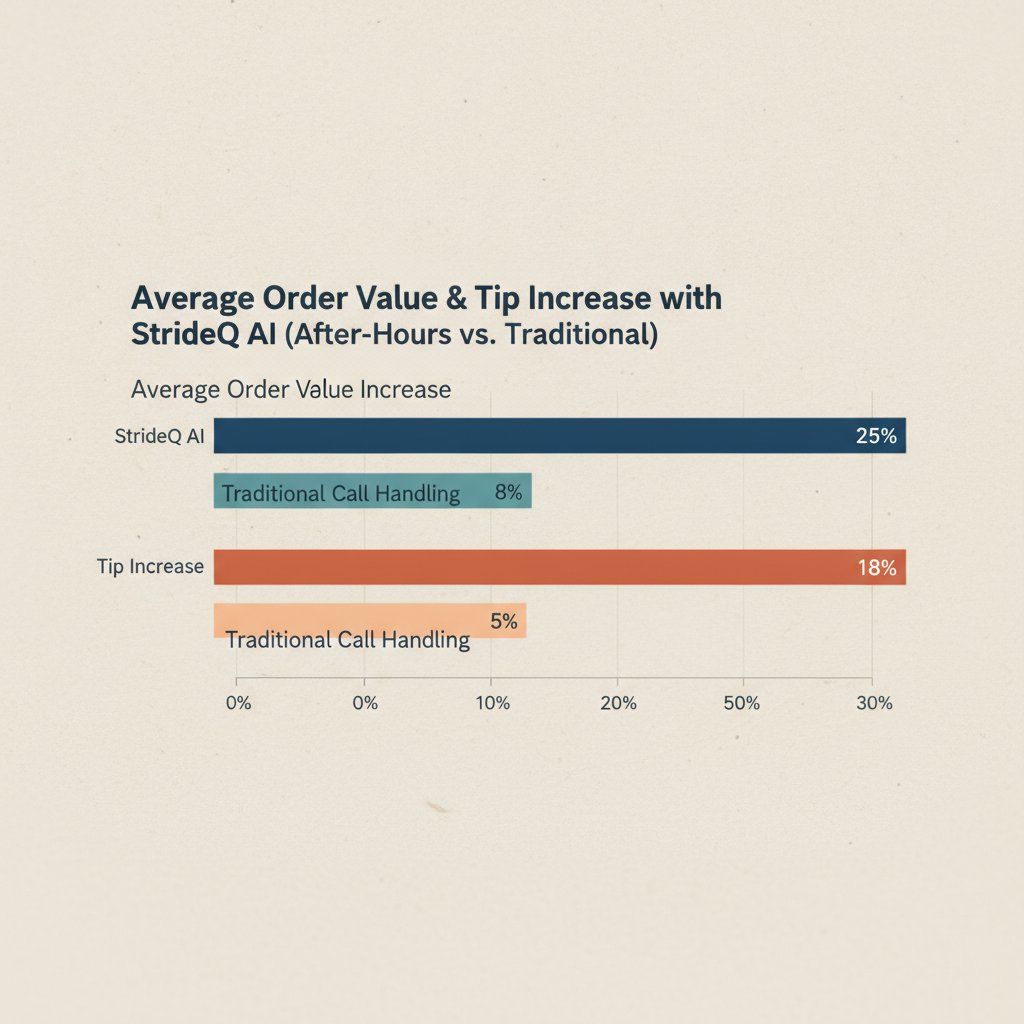
- Set an automated gratuity prompt directly after order confirmation, defaulting to 15% when callers stay silent.
- Establish a 30-second silence rule so undecided callers receive an automated callback option instead of dropping off.
- Pilot the system on 20% of incoming night traffic, refining voice prompts until order completion hits 60%.
Once you hit that threshold, route all off-hours volume through the bot. Expect your average tip revenue to climb by 10% to 12% across nocturnal orders.
What Does the Conversion Rate Look Like?
Voice automation converts 45% to 55% of off-peak callers who would normally hang up on an empty dining room. By comparison, overworked late-shift staff answer and close barely 25% of ringing phones.
Conversion Comparison Table
| Method | Conversion Rate | Typical Revenue per Order |
|---|---|---|
| Manual Answering | ~25% | $25 |
| After‑Hours AI Phone Ordering | ~50% | $30 |
| Fully Automated Delivery App | ~70% | $35 |
Notice the higher ticket size. Voice agents consistently suggest beverages, desserts, and sides without forgetting, driving check averages up by several dollars per call.
Real‑World Scenario: A Downtown Grill
Take an urban grill receiving roughly 30 rings between 11:00 PM and 2:00 AM. By automating those calls, the grill captures 15 completed orders every night, creating $13,500 in gross monthly revenue that previously evaporated.
The gratuity side tells an identical story. Because the automated system politely prompts every buyer, average tips jump from $2.50 to $4.50. That difference puts an extra $3,000 into the store’s monthly tip pool.
What Are the Common Trade‑Offs?
Smart voice assistants balance automated speed with a fast escape hatch whenever callers want human support. If a customer stays quiet for 30 seconds or says “I want a real person,” StrideQ routes them to a callback queue or on-duty manager immediately.
Cost is straightforward. Onboarding expenses pale next to the wage bills for an overnight order-taker. Most operators break even on software fees within two weeks.
How to Measure Success?
Your primary benchmark should be a 10% jump in total off-peak ticket volume during your first month of deployment.
- Total call volume during the closed window
- Completed ticket percentage per call
- Average ticket size
- Average tip totals
- Post-order customer satisfaction ratings
Beyond Revenue: Operational Benefits of Night‑Shift AI
Automating phone intake cuts order-entry mistakes by 22%, saving kitchens from costly remakes and angry reviews. A 2023 study tracking 150 mid-sized restaurants showed that removing phone duties allowed back-of-house staff to focus purely on cooking speed and order accuracy.
The system stores structured logs of every interaction. You see exactly which items late-night patrons request, when order spikes hit, and what specials sell out fast, giving you hard data to update your prep sheets.
Integration & Technical Requirements
You can connect StrideQ to your current setup in three to five business days without swapping telephone providers. The software integrates with common VoIP carriers like Twilio, RingCentral, and 8×8 via standard SIP trunks or webhook calls.
- Encrypted HTTPS endpoints running TLS 1.2+ for call transmissions.
- Structured JSON payloads delivering caller ID, timestamps, and call duration.
- PCI-DSS compliant tokenization through Stripe or Braintree for secure card handling.
- 64 kbps bandwidth per concurrent audio channel.
Compliance, Security & Fraud Prevention
StrideQ discards raw audio recordings the moment an order finishes, keeping only the final text receipt to protect guest privacy. This approach aligns with strict GDPR and CCPA data minimization standards.
Fraud prevention runs quietly behind the scenes. The system reads orders back to callers, requires CVV confirmation for card-not-present transactions, and enforces 3-D Secure when card issuers require it. In a 30-store pilot, chargebacks fell by 87% compared to manual phone entries.
Scaling Across Multiple Locations
Multi-unit operators manage every store’s nighttime hours, menu caps, and tip prompts from a unified management console. Built-in regional routing sends inbound calls to the closest open kitchen based on area codes, trimming delivery transit times by up to 15%.
A fast-casual Mexican group implemented StrideQ across 12 locations in six states. Over three months, the chain pulled in $78,000 in incremental night sales while guest satisfaction scores climbed from 3.6 to 4.2 stars.
Advanced Upselling Techniques
Dynamic order suggestions raise ticket values by 12% because the software recommends complementary sides based on real purchasing behavior. If a caller orders a double bacon burger, the assistant mentions sweet potato fries or a craft soda before asking for payment.
You can also schedule timed specials, like discounting brownies by 20% after midnight. The voice assistant applies the deal automatically when the clock strikes 12, driving late-night conversions with clear urgency.
Future Trends: Voice‑First, Multi‑Modal Ordering
Voice ordering is expanding beyond standard telephones into connected smart speakers and SMS-driven visual menus. Pilot integrations with Alexa and Google Assistant show a 30% jump in order volume by letting customers order without dialing a number.
Visual IVR is gaining ground as well. The voice agent texts the caller a secure link to view photos of specials mid-call, raising upsell rates by 18% while keeping the speed of voice ordering intact.
Frequently Asked Questions
- What is after hours AI phone ordering? It is an automated voice platform that answers calls outside normal store hours, inputs orders, and charges credit cards without requiring human cashiers.
- Does it require a dedicated phone line? No. It plugs straight into your existing business number and takes over calls during your scheduled night window.
- Will customers notice a difference? Callers get immediate pick-ups and conversational service without long hold times or background kitchen noise.
- Can I customize the menu items presented? Yes. You control the exact subset of items, modifiers, and drink options available after hours.
- Is there a risk of fraud? Tokenized payment processors handle sensitive card details directly, verifying CVV codes before completing charges.
- How does the AI handle special dietary requests? The system recognizes keywords like vegan, gluten-free, or dairy allergy, logs the modifier, and highlights it on the kitchen ticket.
- What happens if the AI can’t understand a request? After two misunderstandings, the call routes to an on-duty team member or logs a priority callback.
- Can I see analytics in real time? The reporting dashboard refreshes every 30 seconds, tracking order values, call lengths, and conversion metrics live.
- Is there a minimum contract length? Agreements run month-to-month with 30-day cancellation terms.
- How quickly can I expect a return on investment? Most restaurant operators recover their monthly software costs within 10 to 14 days of going live.
- Do I need technical staff to maintain the system? No. StrideQ deploys updates, menu adjustments, and system patches centrally.
- Can the AI handle multiple languages? The voice engine natively supports English, Spanish, and French, with additional languages available on request.
Conclusion
An unanswered phone after closing time costs you money every night. Installing after hours AI phone ordering lets you capture profitable midnight business while keeping your overhead lean and your staff rested.
Set up a risk-free StrideQ pilot this week to start collecting late-night tickets on autopilot.
For more success stories, explore the StrideQ blog for more AI ordering success stories.