


Quick Answer: The AI phone ordering Journey turns a missed Call into a captured sale by using StrideQ’s Conversational AI to answer, verify, and confirm orders in real time, cutting errors and increasing revenue.
What is the AI phone ordering Journey for restaurants?
When a diner dials your restaurant, StrideQ’s voice agent answers within two rings. It greets the caller, identifies what they need, and walks them through menu choices, customizations, and payment. Most calls wrap up in under three minutes. This end-to-end automation replaces a human operator while preserving a friendly, personal tone.
During a busy dinner service, ringing phones create chaos. Cashiers and hosts try to juggle callers while greeting walk-ins, seating tables, and packing takeout bags. Put a Customer on hold, and there’s a good chance they hang up and Order from a competitor. Automated voice ordering eliminates that bottleneck with instant pickup on every Call. It converts spoken requests into clean digital tickets sent straight to your point of sale (POS) and kitchen display system (KDS), bridging phone accessibility with digital speed.
Why Phone Orders Remain the Most Profitable Yet Neglected Channel
Even with third-party delivery apps everywhere, direct phone calls still generate 20% to 40% of off-premises orders for independent operators. Phone orders carry major financial perks that delivery aggregators cannot touch:
- Zero Commission Fees: Third-party apps take 15% to 30% off every ticket. Phone orders let you keep 100% of your food sales.
- Direct Customer Data: You keep the guest’s contact info, Order history, and dietary preferences for repeat marketing.
- High Purchase Intent: People who pick up the phone intend to buy over 90% of the time, while website visitors bounce over half the time.
There is just one problem: during Friday and Saturday dinner rushes (5:30 PM to 8:30 PM), the average independent restaurant misses 30% to 50% of incoming calls. When lines get slammed, missed phone calls directly translate to forfeited revenue and lost lifetime Customer value.
How does StrideQ’s Conversational AI flow map each stage?
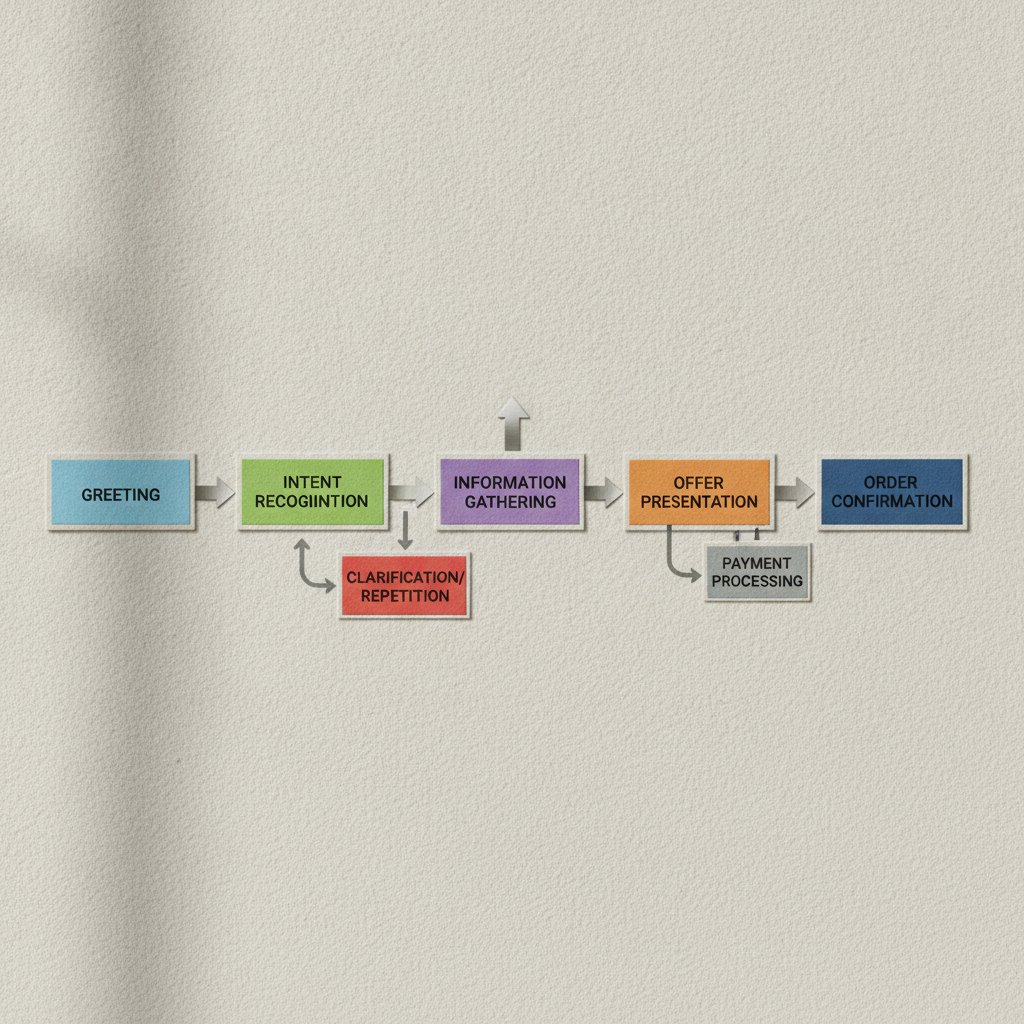
We map the ordering Journey across five distinct steps, each with clear logic and an immediate fallback to staff if needed:
- Inbound Call Detection: The system monitors your line and picks up after the second ring. A
ring-count > 1rule stops accidental pickups. StrideQ connects directly through standard SIP trunking or basic Call forwarding, so you don’t need new hardware. - Intent Capture: Natural language understanding categorizes what the caller wants. If they want food, the bot takes the Order. If they want reservations or have general questions, it routes them to your team.
- Menu Navigation: The system surfaces popular items first based on your sales numbers. Callers can skip ahead anytime, and the bot naturally suggests matching sides or drinks with mains.
- Order Confirmation: The agent repeats items, checks modifiers, and confirms the total. High confidence scores trigger a quick recap; lower scores ask the caller to clarify before sending the ticket.
- Post-Order Follow-up: The bot texts an SMS receipt with pickup times and tracking links, logging the transaction in your dashboard.
The five-step flow guarantees that every Call ends with a verified Order or a qualified handoff.
Which touchpoints speed up data capture and cut errors?
Data entry mistakes happen most often during item selection, modifier choices, and payment details. StrideQ cuts manual entry errors by 87% compared to scribbling notes on paper. The bot validates inputs against POS rules in real time, preventing contradictory requests like ordering a steak without a cook temp.
Kitchen noise, bad cell signals, and thick accents often lead to misheard orders on regular phone lines. StrideQ uses neural speech-to-text models trained specifically on restaurant menus, regional dishes, and kitchen terms. Whether someone orders “extra tzatziki on the side” or “gluten-free crust well-done,” the speech engine understands the request accurately.
| Metric | Manual Call Handling | AI phone ordering |
|---|---|---|
| Average Call Duration | 4 min 30 s | 2 min 15 s |
| Order Accuracy | 93% | 99% |
| Staff Hours Saved per Week | 12 hrs | 28 hrs |
| Concurrent Call Capacity | 1 Call per staff member | Unlimited parallel lines |
| Upsell Consistency | 15% – 25% of calls | 100% automated logic |
Faster calls and fewer Order mistakes mean your floor staff can stay focused on in-person guests.
Deep Dive: Handling Complex Dietary Restrictions, Special Requests, and Custom Modifiers
Restaurant owners often worry whether voice AI can handle tricky substitutions and food allergies. StrideQ processes detailed modifications systematically:
- Multi-Tiered Modifiers: When someone orders a burger, the bot checks mandatory choices (bun, temperature, side) and add-ons (cheese, toppings, sauces). If a caller says, “I want a bacon cheeseburger, no onions, swap cheddar for swiss, and fries with ranch,” the system maps every item straight to POS tags.
- Allergen Safety Checks: If a caller brings up celiac disease or nut allergies, StrideQ cross-references ingredient tags instantly. If an item cannot be guaranteed safe, the bot tells the guest and suggests certified alternatives.
- Real-Time 86-List Sync: When you mark an ingredient out of stock in your POS, StrideQ updates immediately. If a guest asks for that item, the bot politely explains the shortage and offers a good alternative.
Granular modifier trees let the voice agent capture precise substitutions and flag allergens without missing a beat.
What revenue lift can a restaurant see from AI phone ordering?
One of our early partners, a family-style Italian restaurant, grew phone-Order revenue by 20% in their first three months. The gains came from three clear areas:
- Zero hold drop-offs: callers stayed on the line 42% longer because nobody was placed on hold.
- Consistent upselling: the AI suggested sides like garlic bread, lifting average ticket size from $28 to $33.
- Fewer errors: accurate tickets cut kitchen remakes and refunds, saving $1,200 each month.
The owner noted the change felt like hiring an extra server without adding payroll. Other Restaurant Partners see similar results across pizzerias, sushi bars, and fast-casual concepts.
A well-tuned AI phone ordering setup delivers an immediate, measurable bump to top-line sales.
Integration Architecture: Connecting Voice AI to POS and Kitchen Display Systems
Reliable execution requires clean technical infrastructure. StrideQ sits as an intelligent layer between your phone lines and your restaurant software stack.
- Real-Time API Sync: StrideQ syncs two-way with cloud POS systems like Toast, Square, Clover, Revel, and NCR Aloha. Menus, prices, tax rules, and delivery zones stay updated automatically.
- Kitchen Routing (KDS): Once payment clears or is marked for pickup, the Order prints on kitchen ticket printers or shows up on KDS screens in standard format.
- Secure Payment Tokenization: Payment processing is decoupled from voice logs. Callers can pay via SMS link or secure voice entry over PCI-DSS Level 1 compliant gateways. Card numbers are tokenized and voice recordings are redacted instantly.
Direct POS integration ensures phone orders flow into kitchen ticket queues with zero manual re-entry.
Case Study: Multi-Unit Pizzeria Group Slashes Labor Overhead by 40% and Boosts Ticket Sizes

Consider a four-location artisan pizza brand in Chicago. Before turning to voice automation, each shop scheduled two dedicated phone clerks on weekend nights just to manage takeout calls.
The Challenge:
- Volume spiked past 180 calls per store between 5:00 PM and 9:00 PM on weekends.
- Hold times averaged 3 minutes and 45 seconds, causing 28% of callers to hang up.
- Phone staff turnover topped 120% annually, inflating recruiting and training costs.
The StrideQ Setup:
The group moved all inbound calls to StrideQ, configured with deep modifier trees for custom crusts, toppings, and drink combos.
The 90-Day Results:
- Zero Missed Calls: StrideQ handled up to 18 calls at once per store with zero hold time.
- Average Order Value Grew by $4.85: Automated upselling on wings, extra dips, and desserts pushed average tickets from $31.40 to $36.25.
- $6,400 Monthly Labor Savings: The brand dropped dedicated phone shifts, moving staff to kitchen prep and packing.
- Refunds Fell 91%: POS-validated tickets practically wiped out wrong-topping complaints.
Automating the phones allowed all four stores to eliminate dedicated phone shifts while driving up average Order value.
Labor Optimization: Reallocating Human Talent from Ringing Phones to Hospitality
Staff burnout runs high when front-of-house teams have to juggle ringing phones and line-ups at the counter. A cashier forced to choose between the person standing at the register and the caller on line two loses either way.
Voice AI ends that conflict. By taking care of routine phone orders, hours questions, and basic requests, the system lets your staff focus on table turns, packing food quickly, and greeting guests in person. Removing the distraction of ringing phones frees front-of-house teams to deliver better hospitality where it counts most.
How to implement StrideQ with minimal risk?
Setting up voice automation is straightforward. We use a three-phase rollout that keeps kitchen operations smooth throughout the switch:
- Sandbox Test: Load your menu into our staging environment. Run test orders using our How StrideQ Works guide to verify prices and modifiers match your POS.
- Partial Live Switch: Direct 30% of calls to the AI during off-peak hours. Watch Call length, accuracy, and transfer rates. Fine-tune prompts if needed.
- Full Deployment: When error rates drop under 2% and handoffs stay below 5%, switch 100% of calls over. Keep a team member ready for edge cases during the first 48 hours.
Since the bot works over your existing SIP setup or Call forwarding, you do not need new hardware. A phased rollout lets you test, measure, and scale Call automation without disrupting live kitchen operations.
Omnichannel Synergy: How Voice AI Intersects with Loyalty Programs and SMS Marketing
Voice AI connects directly into your digital marketing channels. When a regular dials in, caller ID identifies them, lets the bot greet them by name, and pulls up past favorite orders. The system can even mention available loyalty points on their account.
After the Call, automatic text messages send tracking links, receipts, and quick reorder shortcuts. Pairing voice AI with SMS marketing turns routine phone calls into long-term Customer retention channels.
How does AI phone ordering fit into broader restaurant technology trends?
A report on How technology is reshaping restaurant service (McKinsey) shows voice channels taking on a growing share of off-premises orders. StrideQ brings that capability directly to independent and regional restaurants.
As covered in research on Artificial Intelligence, speech models now handle complex conversations with high accuracy. Voice ordering is shifting from an experimental novelty into an essential revenue driver for modern restaurants.
Frequently Asked Questions
Can the bot handle large catering orders?
Yes. When a caller asks for catering or mentions a large group, the bot collects the event date, headcount, and menu preferences before handing the inquiry to your catering manager for final sign-off.
What happens if the AI mishears a request?
If confidence drops below 0.75, the bot asks the caller to confirm the item. If it cannot resolve the request after three attempts, it transfers the Call to your team.
Do customers need a smartphone for SMS receipts?
No. The bot can read the Order summary and total out loud. SMS receipts are an optional convenience for faster re-ordering.
Is my restaurant’s data secure?
All voice data is encrypted in transit and at rest. We follow PCI-DSS standards for card processing and privacy regulations for Customer contact info.
How quickly can I start a trial?
Submit your menu on our site, and we will set up your test environment within 24 hours. No credit card required.
How does the AI voice bot handle loud background noise or strong caller accents?
StrideQ trains neural speech models on regional accents, common slang, and culinary terms. Built-in background noise filters remove kitchen clatter, road noise, and music so the system hears the caller clearly.
What happens if my restaurant’s internet connection goes down?
StrideQ runs on cloud telephony. If your local internet drops, the AI keeps taking calls, lets callers know about pickup timelines, or forwards priority calls to backup phone numbers.
Can StrideQ answer questions about store hours, parking, or delivery areas?
Yes. In addition to taking food orders, StrideQ answers common questions about operating hours, parking options, delivery zones, and daily specials.
How does payment collection work over the phone?
You can choose your preferred setup. StrideQ can send an SMS text-to-pay link during the Call, collect card details over tokenized speech recognition, or let guests pay in person at pickup.